
What Do Game NFTs Actually Do? Assets, Ownership and What You Can Sell
“NFT game” assets get described with a lot of noise. Strip it back: a game NFT is simply an in-game item recorded on a blockchain instead of only in the developer’s database. What that actually buys you — playability, tradability, or nothing at all — varies enormously per game. This is the mechanics-level version.
The asset types you’ll meet#
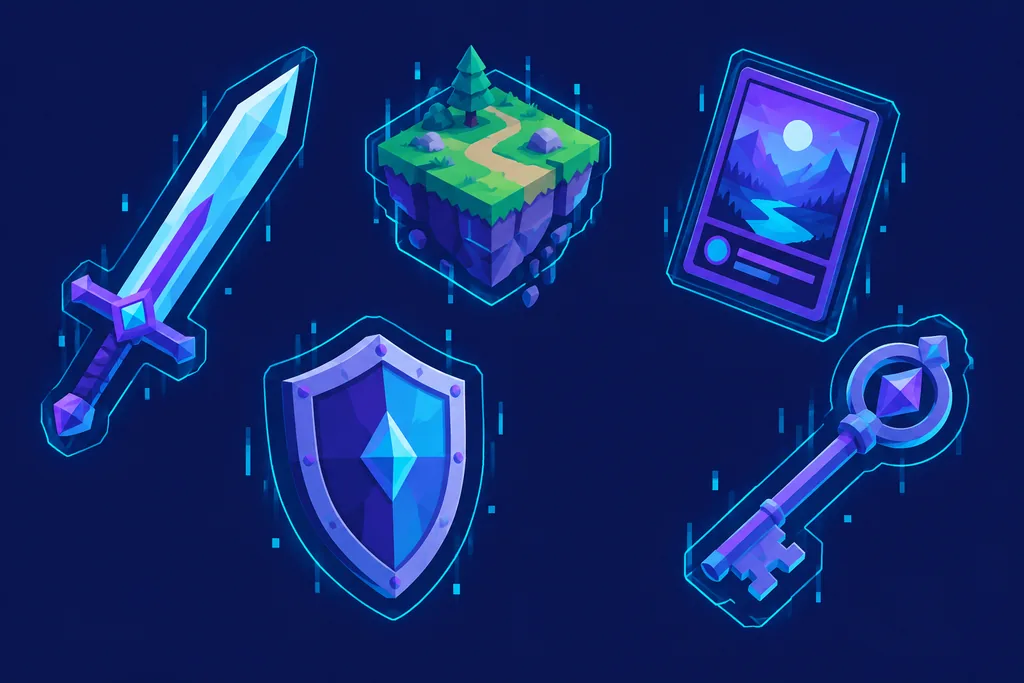
- Characters and creatures — playable pieces, e.g. axies in Axie Infinity: Origins.
- Cards — collectible pieces that are also your deck, e.g. Gods Unchained cards.
- Land — parcels that grant build/play space or resource yield, e.g. LAND in The Sandbox.
- Items and cosmetics — gear, skins, passes, trinkets.
Each registry profile’s “What you own” block summarises the asset types and NFT usage for that specific game — check the profile rather than assuming.
What ownership actually grants#
Three different things get conflated as “ownership”:
- In-game use. The asset functions in the game (the card plays, the character fights). This is the baseline — a non-NFT account item does the same.
- Transferability. The asset sits in your wallet, so you can sell or trade it on a marketplace outside the game — the actual distinction of on-chain assets.
- Persistence. The token survives the game itself existing — important, and darker than it sounds (see below).
What ownership does not grant: any claim on the game’s code, its servers, its future development, or a promise the item stays useful. You own the token; the game licenses its meaning.
Where assets trade#
Each ecosystem has its own market layer: App.axie (Mavis Market) on Ronin for games like Pixels and Axie, the Immutable marketplace and TokenTrove for Gods Unchained cards, and the game’s own marketplace where one exists — The Sandbox‘s marketplace for LAND, Splinterlands‘ internal market for cards and land. Registry profiles list the relevant marketplaces per game.
A note on prices: this site doesn’t track or discuss asset prices. Whether something is worth anything is your own research; our records describe what the asset is, not what it costs.
Custody: your wallet vs the game account#
Game progress and un-minted items typically live on the game’s servers under your account. On-chain assets live in your wallet, controlled by your keys — which is why wallet security matters: anyone holding your seed phrase owns your assets. The custody fundamentals are at NFTUniverse; here the practical point is narrower — never share a seed phrase with a game, and connect your wallet only at the official site.
What happens to assets when a game dies#
This is the honest part most coverage skips. Your tokens persist — the game can be gone while the asset still sits in your wallet. But an asset without its game is usually inert:
- Axie Infinity: Homeland was sunset in June 2026, replaced by Terrariums land gameplay. Players kept their land and axies — the tokens remain — but the game that used them was retired, with rewards transitioning to the new system.
- Pirate Nation went fully offline in September 2025; the studio open-sourced the code and released the art under CC0 in August 2026. Founder Pirates NFTs still exist in wallets — as art, without a live game.
Ownership outlives the game. Utility usually doesn’t. How to check whether a game is still alive covers the verification side.
Reading a profile’s “What you own” block#
Every registry profile condenses this into three fields: NFT usage (what role assets play — none, cosmetic, playable-assets, land, mixed), asset types (the concrete items), and wallet requirement (none / optional / required-to-play / required-for-assets). Start there before buying anything.
Sources#
- Official Axie blog — Terrariums launch and Homeland sunset
- The Defiant — Proof of Play shutdown and open-sourcing
- Gods Unchained official site · The Sandbox official site
- Registry profiles linked above — each carries its own sources and last-verified date.
This guide was verified against primary sources on 2026-09-18.
