
What Do Game NFTs Actually Do? Assets, Ownership and What You Can Sell
“NFT game” assets get described with a lot of noise. Strip it back: a game NFT is simply an in-game item recorded on a blockchain instead of only in the developer’s database. What that actually buys you — playability, tradability, or nothing at all — varies enormously per game. This is the mechanics-level version.
The asset types you’ll meet#
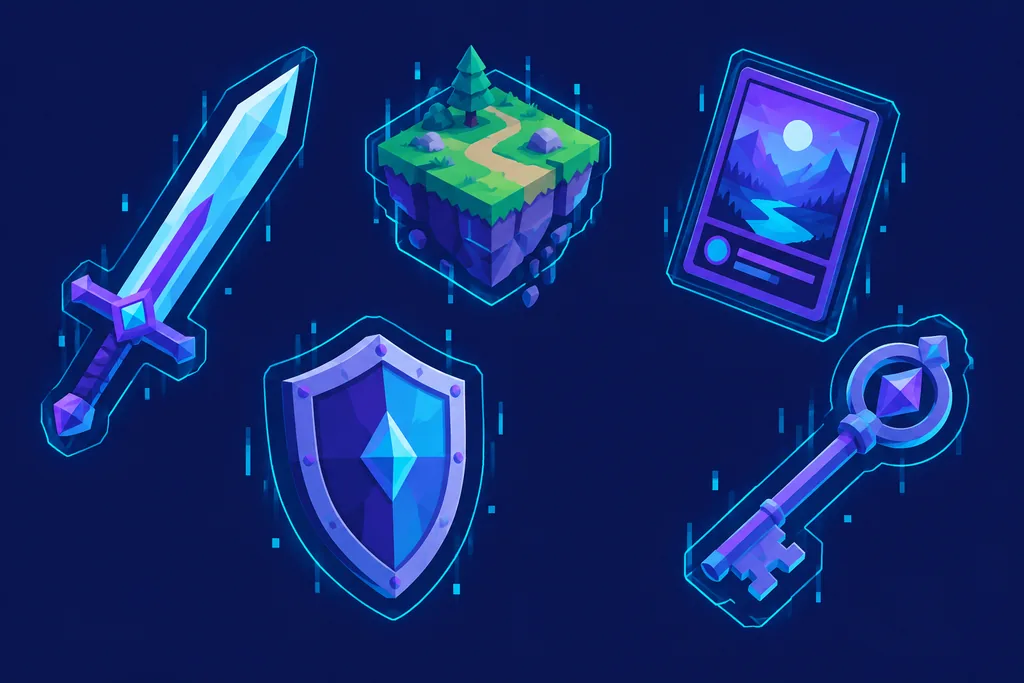
- Characters and creatures — playable pieces, e.g. axies in Axie Infinity: Origins.
- Cards — collectible pieces that are also your deck, e.g. Gods Unchained cards.
- Land — parcels that grant build/play space or resource yield, e.g. LAND in The Sandbox.
- Items and cosmetics — gear, skins, passes, trinkets.
Each registry profile’s “What you own” block summarises the asset types and NFT usage for that specific game — check the profile rather than assuming.
What ownership actually grants#
Three different things get conflated as “ownership”:
- In-game use. The asset functions in the game (the card plays, the character fights). This is the baseline — a non-NFT account item does the same.
- Transferability. The asset sits in your wallet, so you can sell or trade it on a marketplace outside the game — the actual distinction of on-chain assets.
- Persistence. The token survives the game itself existing — important, and darker than it sounds (see below).
What ownership does not grant: any claim on the game’s code, its servers, its future development, or a promise the item stays useful. You own the token; the game licenses its meaning.
Where assets trade#
Each ecosystem has its own market layer: App.axie (Mavis Market) on Ronin for games like Pixels and Axie, the Immutable marketplace and TokenTrove for Gods Unchained cards, and the game’s own marketplace where one exists — The Sandbox‘s marketplace for LAND, Splinterlands‘ internal market for cards and land. Registry profiles list the relevant marketplaces per game.
A note on prices: this site doesn’t track or discuss asset prices. Whether something is worth anything is your own research; our records describe what the asset is, not what it costs.
Custody: your wallet vs the game account#
Two separate layers exist in every blockchain game, and conflating them is the most common source of confusion:
- The game account holds your progress, settings, and off-chain items — it lives on the developer’s servers like any normal game account.
- The wallet holds your on-chain assets — it is yours on the blockchain, independent of the game’s servers.
Plenty of games let you play entirely in the first layer: the profile’s wallet requirement field tells you which is which — none/optional means you never have to touch crypto at all, required-for-assets means you can play free but need a wallet to own or trade, and required-to-play means the wallet is the front door. Where a wallet is needed it may be a hosted one (WAX Cloud Wallet, Immutable Passport) rather than a seed-phrase wallet — check the profile’s access requirements before assuming what “wallet required” means in practice.
What happens to assets when a game dies#
This is the honest part most coverage skips. Your tokens persist — the game can be gone while the asset still sits in your wallet. But an asset without its game is usually inert:
- Axie Infinity: Homeland was sunset in June 2026, replaced by Terrariums land gameplay. Players kept their land and axies — the tokens remain — but the game that used them was retired, with rewards transitioning to the new system.
- Pirate Nation went fully offline in September 2025; the studio open-sourced the code and released the art under CC0 in August 2026. Founder Pirates NFTs still exist in wallets — as art, without a live game.
Ownership outlives the game. Utility usually doesn’t. How to check whether a game is still alive covers the verification side.
Reading a profile’s “What you own” block#
Every registry profile condenses this into three fields: NFT usage (what role assets play — none, cosmetic, playable-assets, land, mixed), asset types (the concrete items), and wallet requirement (none / optional / required-to-play / required-for-assets). Start there before buying anything.
Common questions#
Do you need crypto to play NFT games?#
No — it depends on the game, and our registry marks it per record: none/optional means you never touch crypto, required-for-assets means free play with a wallet only for owning items, and required-to-play means the wallet is the front door. Where a wallet is needed it is often a hosted one (WAX Cloud Wallet, Immutable Passport) rather than a seed-phrase wallet.
Can you sell a game NFT for real money?#
If the asset is transferable — most on-chain items are — you can list it on the ecosystem’s marketplace: App.axie on Ronin, the Immutable marketplace or TokenTrove on Immutable, or a game’s own market where one exists. Transferable is not the same as liquid; a listing is not a sale. This site doesn’t track prices.
What happens to your NFTs if the game shuts down?#
The tokens stay in your wallet — ownership outlives the game. But an asset without its game is usually inert: Axie Homeland’s sunsetting moved players to Terrariums, while Pirate Nation’s NFTs persist as art after the studio open-sourced the code. The shutdown research documents more cases.
Are game NFTs an investment?#
We don’t treat them as one. An NFT’s in-game usefulness is a design choice studios can and do change, and this site records what the asset is — its type, chain and wallet requirement — not what it might be worth. Any value judgement is your own research.
What’s the difference between a game account and a wallet?#
Two separate layers: the game account holds progress and off-chain items on the developer’s servers; the wallet holds on-chain assets under your control. Confusing the two is the most common misunderstanding — the custody section above maps which layer does what.
Sources#
- Official Axie blog — Terrariums launch and Homeland sunset
- The Defiant — Proof of Play shutdown and open-sourcing
- Gods Unchained official site · The Sandbox official site
- Registry profiles linked above — each carries its own sources and last-verified date.
This guide was verified against primary sources on 2026-09-18.